

An-Hacking : episode 12 #open_source 🛵
Open-Source : a decade of Growth, Medusa, let's compare leading OS platforms, deep dive into Headless and a focus on hosting.

Hello all!
I don’t know about you, but March was a very special month for me.
First, I turned 30! I know some friends of mine are reading this—thank you all for your kind messages! Can’t wait to see you folks.
Then, I attended my first One to One Monaco—what an experience! It’s safe to say it was one of the most energizing and insightful events I’ve ever participated in.
Last but not least, I’ve prepared this episode, and I can confidently say it might be the most ambitious one I’ve ever released. Some people told me An-Hacking was too Shopify-oriented—so I’m excited to drop Episode 12, dedicated entirely to Open-Source, its challenges, and its evolution.
Let’s go! 🚀
On today’s program :
The evolution of Open-Source E-Commerce 🚀
Medusa.js : the OS revolution 🛸
Comparing leading OS and Hybrid platforms 🤓
Musical interlude
Headless is the new black ? 👀
Show me the
moneyhosting 🏠Bonus 🎁
1. A decade of Growth
Over the past 10 years, open-source e-commerce platforms have undergone significant transformations. Here are some of the most impactful developments:
1. The Rise of API-First and Headless Architectures
The monolithic approach to e-commerce—where the front-end (storefront) and back-end (product management, checkout, payment, etc.) are tightly coupled—has slowly given way to headless commerce. Open-source platforms like Medusa.js, Magento, and Saleor have embraced API-first approaches, allowing brands to build fully custom storefronts while maintaining a flexible commerce backend.
2. Magento’s Shift & the Growth of Alternatives
Magento, once the uncontested leader in open-source e-commerce, changed drastically after its acquisition by Adobe in 2018. With Adobe pushing Magento Commerce (its paid version), the open-source community started looking for lighter, more agile alternatives. This opened the door for solutions like Medusa.js, Sylius, and Vue Storefront to gain traction.
3. The Shift Toward Composable Commerce
Modern e-commerce no longer relies on single, all-in-one platforms. Instead, businesses are adopting composable commerce, where they piece together best-in-class solutions for payments, inventory, analytics, and customer experience. Open-source platforms have led the way in this shift, enabling merchants to integrate tools like Algolia, Klaviyo, and headless CMSs like Storyblok or Sanity.
4. Developer-Friendly Ecosystems
The last decade has seen open-source projects heavily focus on developer experience (DX). Platforms like Medusa.js, Shopware, and Sylius offer extensive documentation, REST/GraphQL APIs, and community-driven plugin systems, making it easier for businesses to build and scale custom e-commerce experiences.
5. Open-Source SaaS & Hybrid Business Models
The emergence of open-source SaaS models has further driven the adoption of open-source e-commerce. Companies now provide fully managed cloud hosting and enterprise support while keeping their core technology open-source. This trend has helped businesses adopt open-source solutions without the complexity of self-hosting and infrastructure management.
Whats’ next ?!
Open-source e-commerce has come a long way in the last decade, evolving from monolithic, self-hosted platforms to modular, API-first, and composable solutions. The industry is now at a crossroads—while proprietary SaaS platforms continue to dominate, the demand for flexible, customizable, and developer-friendly solutions is stronger than ever.
The next few years will determine whether open-source commerce can bridge the gap between developer control and merchant usability—a challenge that could redefine the future of e-commerce. 🚀
2. Medusa.js : the OS revolution in E-commerce
I was looking forward discussing with you all about Medusa — here we are!
Mid-2024, I discovered Medusa while seeking for emerging open-source platforms. Why ? Following discussions with people from the e-commerce ecosystem, it appears that leading platforms don’t allow merchants and agencies to build 100% custom experiences due to “native silos” — some of them have reached a glass ceiling regarding personalization possibilities.
In the fast-evolving world of e-commerce, Medusa.js is emerging as a game-changer for developers seeking flexibility, scalability, and full control over their online stores. But what makes this open-source headless commerce platform so disruptive?
Why Medusa.js stands out
Unlike monolithic platforms like Shopify or Magento, Medusa.js provides a modular and API-driven approach to e-commerce. It enables developers to build custom commerce experiences without vendor lock-in, leveraging a Node.js-based backend with a flexible plugin architecture.
Here’s why it’s making waves in the open-source ecosystem:
Headless & API-First – Seamlessly integrate with any front-end framework (Next.js, React, Vue, etc.).
Modular by Design – Easily extend and customize functionalities like payment, shipping, and order workflows.
Open-Source & Self-Hosted – No platform fees, total control over data, and the ability to tailor commerce logic.
Fast & Scalable – Built with modern tech, it allows businesses to scale efficiently without bloated architecture.
The Open-Source disruption
Medusa.js embodies the spirit of open-source innovation, challenging proprietary platforms by giving developers the freedom to build unique e-commerce solutions. Its growing community-driven ecosystem is fueling rapid adoption, with more businesses opting for an agile, cost-effective alternative to traditional SaaS commerce platforms.
If you're looking for a Shopify alternative that empowers developers with true flexibility, Medusa.js is one to watch.
Want to explore more?
👉 Check out Medusa.js and start hacking your commerce stack today!
3. Comparing leading OS and Hybrid Platforms
Each of these platforms has its own strengths and weaknesses, making the choice highly dependent on business needs:
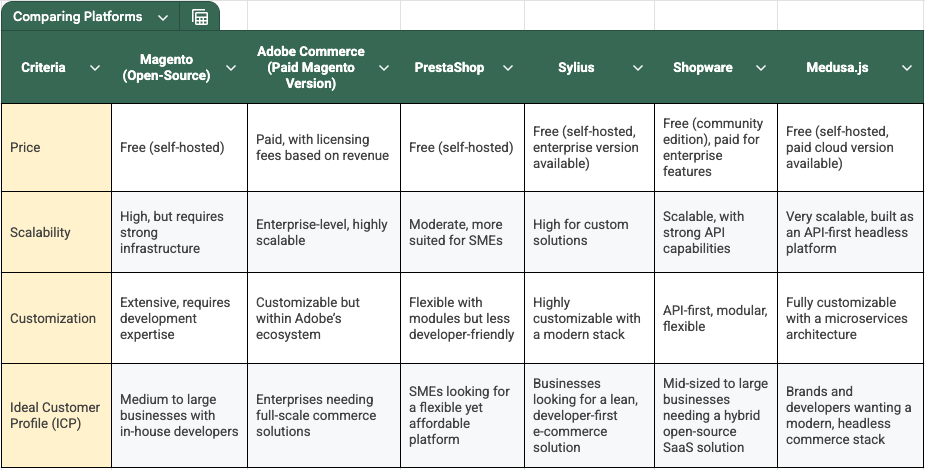
Magento (Open-Source): Great for businesses wanting an established, customizable open-source platform but willing to handle self-hosting.
Adobe Commerce: Offers enterprise features and strong support, but comes with significant costs.
PrestaShop: A good balance for SMEs that need affordability and flexibility without excessive technical complexity.
Sylius: A modern, developer-friendly framework that suits businesses needing high customization.
Shopware: Ideal for businesses wanting a hybrid approach with scalability and modularity.
Medusa.js: A promising API-first, headless e-commerce platform tailored for brands needing flexibility and modern architecture.
With open-source e-commerce evolving towards headless and composable architectures, the next few years will determine which solutions best balance developer flexibility, merchant usability, and business scalability.
Before jumping into musical interlude, please let me know what you think about this brand new episode 👇
Musical Interlude
As I push my own limits with this 12th episode, I figured you should too — today I wanna share something that should be a far cry from what most of you usually listen to.
For those reading An-Hacking since the beginning, you know techno music is the love of my life (hope my wife doesn’t read this!) — I also consider Daft Punk as being one of the most inspiring projects of the past 35 years.
Today I wanna take you back to 1994, three years before DP’s debut album Homework (including iconic tracks such as Da Funk, Teachers, or Oh Yeah) released through Soma Records. 1993 marks Daft Punk’s debut with a solid, energetic 4 bangers techno release : The New Wave.
Here is one of the tracks included in this EP, by the way one of my all time favorite techno songs : Assault.
Fasten your seat belt.
4. Headless is the new black ?
As we said earlier, “traditional” e-commerce platforms (Shopify, Magento, WooCommerce) are monolithic—they bundle the front-end (your website) and back-end (product management, orders, payments) into one system. Headless commerce breaks that connection, allowing brands to build a fully custom shopping experience while keeping a powerful back-end intact.
How it works
With headless, your e-commerce back-end becomes an API-first system. Your storefront—whether it’s a website, mobile app, social commerce integration, or even a voice assistant—fetches product data, pricing, and inventory from the back-end through APIs. Instead of being locked into rigid templates, brands can design their own UX from scratch with frameworks like Next.js, React, Vue.js, or any other front-end tech.
Why brands are going Headless
Performance & Speed → Faster load times and smoother interactions, improving conversion rates.
Full Customization → No more template limitations—build exactly what fits your brand.
Omnichannel Flexibility → Power multiple storefronts (web, mobile, marketplaces, IoT) from one unified back-end.
Scalability → Easily adapt and integrate new tools (CMS, payments, AI, personalization engines) as your business grows.
Who’s using it?
Major players like Nike, ASOS, and Net-a-Porter have gone headless to supercharge their e-commerce experiences. But it’s not just for enterprise—more DTC brands and scaling e-commerce players are leveraging headless to escape platform constraints and build future-proof online stores.
If you’re feeling boxed in by Shopify’s rigid front-end or Magento’s complexity, headless lets you own your tech stack while keeping a solid commerce engine running behind the scenes. More control, better UX, and a faster, more adaptable e-commerce setup. 🚀
If you're using Shopify as your back-end but want to build a custom front-end experience, here are some headless commerce solutions that allow you to connect to Shopify via its APIs:
Hydrogen → Shopify’s own React-based framework for headless storefronts, optimized for performance and Shopify APIs.
Shogun Frontend → A no-code/low-code solution built for Shopify merchants who want to go headless with a pre-built front-end system.
Nacelle → A serverless headless commerce platform that integrates with Shopify and provides a fast, scalable API layer.
Sanity → A headless CMS that integrates seamlessly with Shopify for managing content-rich shopping experiences.
Alokai → A front-end PWA framework that works with Shopify and other e-commerce platforms for fast, mobile-first experiences.
Next.js → A flexible React framework often used with Shopify’s Storefront API for server-side rendering and better performance.
Storyblok → A powerful headless CMS that integrates with Shopify to manage and deliver highly customizable content-driven experiences.
5. Hosting
In e-commerce, every second counts. A slow, unreliable website can mean abandoned carts, lost revenue, and frustrated customers. While many merchants focus on front-end design, payment gateways, and marketing strategies, one of the most critical factors in e-commerce success is hosting.
Hosting directly impacts website speed, security, scalability, and uptime, making it a key decision for any online store. In this article, we’ll explore why hosting matters, the key challenges businesses face, and examples of good hosting strategies in e-commerce.
1. Website performance & load speed
Customers expect fast page load times, and search engines like Google prioritize speed in their rankings. Studies show that a 1-second delay in page load time can reduce conversions by up to 7%. This means that slow hosting can cost businesses thousands (or even millions) in lost revenue.
🔹 Example: Amazon has reported that every 100ms of latency costs them 1% in sales. For a high-traffic e-commerce site, this is a major concern.
2. Scalability & handling traffic spikes
E-commerce traffic is unpredictable. Whether it’s Black Friday, a flash sale, or an influencer promotion, sudden spikes in traffic can crash unprepared websites.
🔹 Example: In 2021, several major retailers saw site crashes during Black Friday due to inadequate hosting capacity. Choosing a scalable hosting solution prevents revenue loss during high-traffic events.
3. Security & data protection
E-commerce sites handle sensitive customer data, including payment information, addresses, and login credentials. Poor hosting security can lead to data breaches, compliance violations, and loss of customer trust.
🔹 Example: In 2020, over 2,800 Magento stores were hacked in a massive attack due to outdated security patches. Secure hosting solutions help prevent such vulnerabilities.
4. Uptime & reliability
Downtime means lost sales. Even a few minutes of downtime can be extremely costly, especially for high-volume e-commerce stores.
🔹 Example: In 2022, Shopify experienced a 45-minute outage, disrupting thousands of merchants and causing significant revenue loss.
Bonus : no bonus !
Maybe you noticed there was no guest in this episode — and you'd be absolutely right!
As I mentioned, this episode is probably the most challenging and ambitious edition of An-Hacking so far. I chose to dive deep into a topic that’s quite far from what I usually explore.
And right now, I think we’re done. I let you digest the all episode.
No bonus content this time, but feel free to share your thoughts — I'm super curious (and, not gonna lie, a bit nervous 😅) about how it’ll land!
Have a nice week and a great Q2!
Best 🫶
Thanks for the great content, appreciate the examples on the hosting section, will keep in mind the revenue to latency lever. On another note, could you give some examples of what we might be able to accomplish with Medusa that wouldn't be possible with Shopify? Is it for example customizing checkout ?
Keep up the insightfull work !